Unlocking Innovation: How the FTC’s Ban on Noncompetes Could Revolutionize the Business Landscape

In a transformative decision, the Federal Trade Commission (FTC) has issued a final rule banning noncompete agreements nationwide, aiming to boost market competition and innovation. This rule is set to free thousands of workers from restrictive agreements, enhancing their ability to innovate and pursue better job opportunities.
FTC Chair Lina M. Khan emphasized the negative impact of noncompetes on wages, innovation, and economic dynamism. The abolition of these agreements is expected to result in the creation of over 8,500 new businesses annually and a significant increase in patent filings—potentially between 17,000 to 29,000 each year.
The rule also promotes the use of Non-Disclosure Agreements (NDAs) as a viable alternative to protect sensitive business information without restricting employee mobility. This approach supports a competitive environment where ideas and talent can circulate freely.
This bold initiative by the FTC marks a significant shift towards a more dynamic and competitive economic landscape, promising higher wages and a surge in business and technological innovation. For businesses and workers navigating this new terrain, expert legal guidance, such as that offered by Ward Law Office will be essential.
If you have any questions, or if interest in securing NDAs for use in your business, do not hesitate to contact Ward Law Office by telephone at 419-408-5500 or via email at info@wardpatent.com,
FTC Announces Rule Banning Noncompetes | Federal Trade Commission
LTU establishing National Academy of Inventors Chapter.
The intellectual property law firm of Ward Law Office LLC is a proud sponsor of this new chapter of the National Academy of Inventors at Lawrence Technological University. Press release below and very exciting news indeed!

SOUTHFIELD—Lawrence Technological University is in the process of establishing a new chapter of the National Academy of Inventors.
NAI is a nonprofit membership organization based in Tampa, Fla., formed in 2010 at the University of South Florida to encourage inventors in academia.
NAI now has more than 4,600 individual members, including NAI Fellows, Senior Members, and Chapter Members, affiliated with approximately 260 institutions—U.S. and international universities, governmental agencies, and nonprofit research institutes—worldwide. Fellows must be named as an inventor on at least one United States patent and are selected by the NAI Fellows Committee.
The formation of the LTU NAI chapter was spearheaded by longtime LTU engineering technology professor Ken Cook, holder of some 25 U.S. patents. Cook, whose teaching career at LTU spanned seven decades, passed away March 21 at the age of 82.
The members admitted to LTU’s chapter will be comprised of the University’s most prolic inventors, encompassing alumni, faculty, students and friends.
LTU President Tarek M. Sobh said the formation of the chapter is meant to honor Cook’s memory, to help recognize LTU’s inventors and innovators, and to encourage LTU faculty to pursue U.S. patents for the innovations they create through the university’s growing reserach effort.
“Ken Cook was a prolific inventor, and we have many other true innovators among our distinguished faculty, students, and alumni community,” Sobh said. “We believe an NAI chapter at LTU is a natural extension of our increasing level of research sophistication.”
An informational meeting for all those who would be interested in participating in an LTU NAI chapter will be held as part of the University’s annual Research Day, Friday, April 19. The meeting will be held from 2 to 3 p.m. in Room M336 of the LTU Buell Building, building 5 at http://www.ltu.edu/map.
The chapter is sponsored by the intellectual property law firm Ward Law Office LLC, with offices in Southfield and Tiffin, Ohio.
Organizers plan to conduct two meetings per year, nominate members for national recognition, share member success stories, educate the community on patent pursuit, and send LTU chapter representatives to the NAI’s annual national conference.
https://www.ltu.edu/content/news/ltu-establishing-national-academy-of-inventors-chapter
#inventors #entrepreneurs #inventing #patents #wardlawoffice #ltu
The TPTR Patent Method – Live Webinar Wednesday, January 24, 2024 at 2PM EST.

Webinar Description: Experts will walk you through the TPTR 7-step approach to convert your groundbreaking idea into a tangible business success. The 7-step TPTR approach has helped clients turn imagination into productivity, strategy into growth, and ambition into achievement. Discover the TPTR process and unlock the full potential of your design idea.
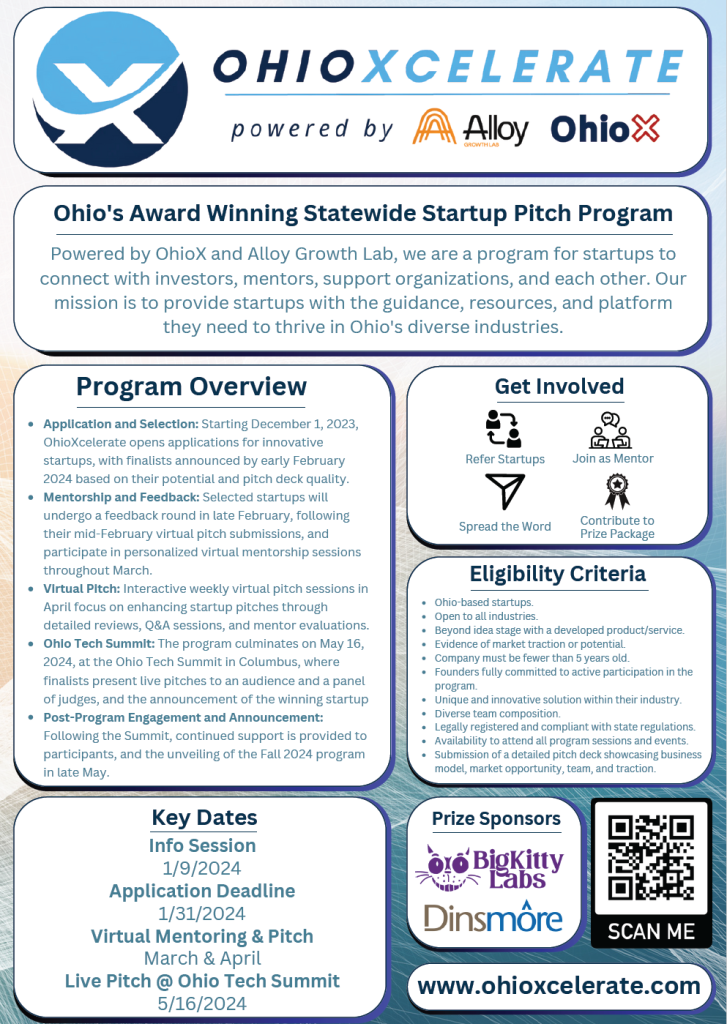
OhioXcelerate! Award Winning Statewide Startup Pitch Program – Information Session January 9, 2024, 9am-10am ET.
Powered by OhioX and Alloy Growth Lab, this is a program for startups to connect with investors, mentors, support organizations, and each other. Their mission is to provide startups with the guidance, resources, and platform they need to thrive in Ohio’s diverse industries.
Information Session January 9, 2024, 9am-10am ET. – Program Overview, Application Process, Mentorship and Support, Virtual Pitch, Ohio Tech Summit, Benefits of Participation, Q&A, visit ohioxcelerate.com for more info!
OhioXcelerate Info Session
Tuesday, January 9 · 9:00 – 10:00am
Time zone: America/New York
Google Meet joining info
Video call link: https://meet.google.com/bfb-ftdq-pvv
Or dial: (US) +1 501-737-0163 PIN: 511 801 498#
More phone numbers: https://tel.meet/bfb-ftdq-pvv?pin=577451724099
Click on the image below to visit the OhioXcelerate! website, where you can apply or learn more about the 2024 program.
IP Legal Assistant at Ward Law Office, Full-time Remote Position

Ward Law Office LLC (WLO) is a virtual “IP boutique” law firm with attorneys and staff located primarily in Ohio and Michigan. WLO has an immediate opening for an IP Legal Assistant with a minimum of 2 years’ experience in a patent and/or trademark prosecution law firm. The ideal candidate has excellent communication skills and will be familiar with legal forms and procedures for filing patent and trademark documents at the USPTO. Experience with docketing practices including the AppColl intellectual property management software is preferred, but is not required. This is a full-time remote position with opportunities for training and advancement in a fast-paced and rewarding environment.
WLO represents a wide variety of clients ranging from independent inventors to Fortune 500 companies, in many different industries and technologies. The firm was founded to provide high quality patent and trademark services while also being flexible to meet the unique needs of our clients. Our passion is helping and educating inventors, entrepreneurs, and small businesses. If you share this passion, we are the right firm for you.
To apply, please submit your resume and cover letter to Kristi Ward, Firm Administrator, at kristi@wardpatent.com. For more information about the firm, applicants are encouraged to visit our website at www.wardpatent.com.
Season’s Greetings 2023 from Ward Law Office.

http://www.wardpatent.com
Happy Thanksgiving 2023 from Ward Law Office.
Happy Thanksgiving from Ward Law Office | Registered Patent Attorneys! We are grateful for our amazing clients, and for our awesome colleagues who help us support the inventing community every day! #Thanksgiving #Patents #Trademarks #Inventions


 Anticipate This!™ | Patent and Trademark Law Blog
leave a comment